CASAN Framework
The AI-Native
Transformation Framework
Many enterprises ask not whether AI works, but why their AI pilots fail to scale and why productivity gains don't translate into measurable business outcomes. CASAN is a 5-level maturity model designed to help organizations assess their current AI readiness, establish robust technical architectures, and safely delegate real work to AI agents to generate measurable business value.
Maturity Model
The five levels of AI transformation
Each level represents a distinct organizational capability and a clear set of actions to advance.
Curious
— The Craft WorkshopThe enterprise is in the early experimentation phase. Employees use public AI tools for individual tasks without standard data, formal governance, or clear business objectives. The goal is to move from unsafe, fragmented experimentation to officially supported and guided AI usage.
Key Actions
- Establish an Acceptable Use Policy — define clear rules on how AI can be used.
- Secure your data — restrict sensitive or proprietary data from public AI tools.
- Provide official enterprise licenses to ensure a secure environment.
- Target 5–10 quick-win use cases that visibly boost daily productivity.
- Train the workforce on AI literacy, safe usage, and basic prompt engineering.
- Measure early impact — time saved, task completion rates, employee satisfaction.
Augmented
— The Assembly LineAI officially augments human daily work. The company provides licensed tools and establishes basic data loss prevention and usage policies. Personal and small-team productivity improves, but AI has not yet transformed broader enterprise processes. The focus shifts from individual productivity boosts to standardized, repeatable organizational capabilities.
Key Actions
- Prioritize use cases — build a centralized portfolio ranked by business impact, feasibility, and risk.
- Standardize and protect data — data classification, sensitivity labels, access controls, and DLP.
- Define the AI lifecycle — approval, build, test, deploy, monitor, and retire.
- Build centralized assets — reusable prompt libraries, agent templates, validation suites.
- Establish dedicated governance — form an AI Governance Board with AI Product Owners, Data Owners, and Security Owners.
Standard
— The Smart FactoryAI capabilities become repeatable and controlled. The enterprise standardizes its data, processes, and platforms, implementing formal AI governance, reusable prompt libraries, validated AI architectures, and dedicated AI roles. To progress further, the company must transition from standardized tools to trusting AI Agents to execute end-to-end workflows.
Key Actions
- Select automated workflows with a clear ROI and controllable risks.
- Design an AI Delegation Architecture — define boundaries, tools, and human-approval gates.
- Build a control plane — manage Agent identities, permissions, audit trails, and rollback procedures.
- Establish AgentOps — monitor AI Agent performance, costs, latency, and hallucination rates.
- Shift the human role from checking every output to managing exceptions and reviewing high-risk tasks.
Automated
— The Automated EnterpriseAI Agents are trusted to operate end-to-end workflows at scale. Under an AI Delegation Architecture, AI executes technical and business processes within strict boundaries. Humans shift from doing the work to managing exceptions and reviewing AI outputs. The next leap requires moving from automating isolated workflows to re-architecting the entire business around AI.
Key Actions
- Redefine the operating model — redesign core processes to be event-driven and AI-orchestrated.
- Build an enterprise knowledge layer — a real-time memory and knowledge base all AI Agents can securely access.
- Implement Multi-Agent orchestration — deploy specialized AI Agents that collaborate on complex problems.
- Upgrade data pipelines — support real-time inference, continuous feedback loops, and continuous learning.
- Shift KPIs — measure new business models, revenue growth, customer experience, and organizational learning speed.
Native
— The Intelligent OrganismThe organization is fundamentally re-architected with AI as its core operating system. Core processes are event-driven, contextual, and orchestrated by multi-agent systems, driving continuous learning, new business models, and significant revenue growth. At this pinnacle, the focus is maintaining the ecosystem and driving continuous innovation.
Key Actions
- Maintain adaptive governance — continuously adapt risk management and security policies for autonomous multi-agent interactions.
- Drive business model innovation — leverage AI-Native infrastructure to launch new products, services, and revenue streams that traditional competitors cannot match.
Transformation Journey
From Curiosity to AI-Native
How a traditional enterprise evolves through each CASAN level.
Employees use free AI tools individually — marketing brainstorms ad copy, developers debug code. No official strategy, data is unverified, and sensitive data may leak. AI is a fragmented experiment, not a business driver.
The CEO steps in, purchases enterprise licenses, and issues an Acceptable Use Policy. Employees safely draft emails, review contracts, and screen resumes. Productivity spikes — but leadership hits a plateau: old processes are just running faster.
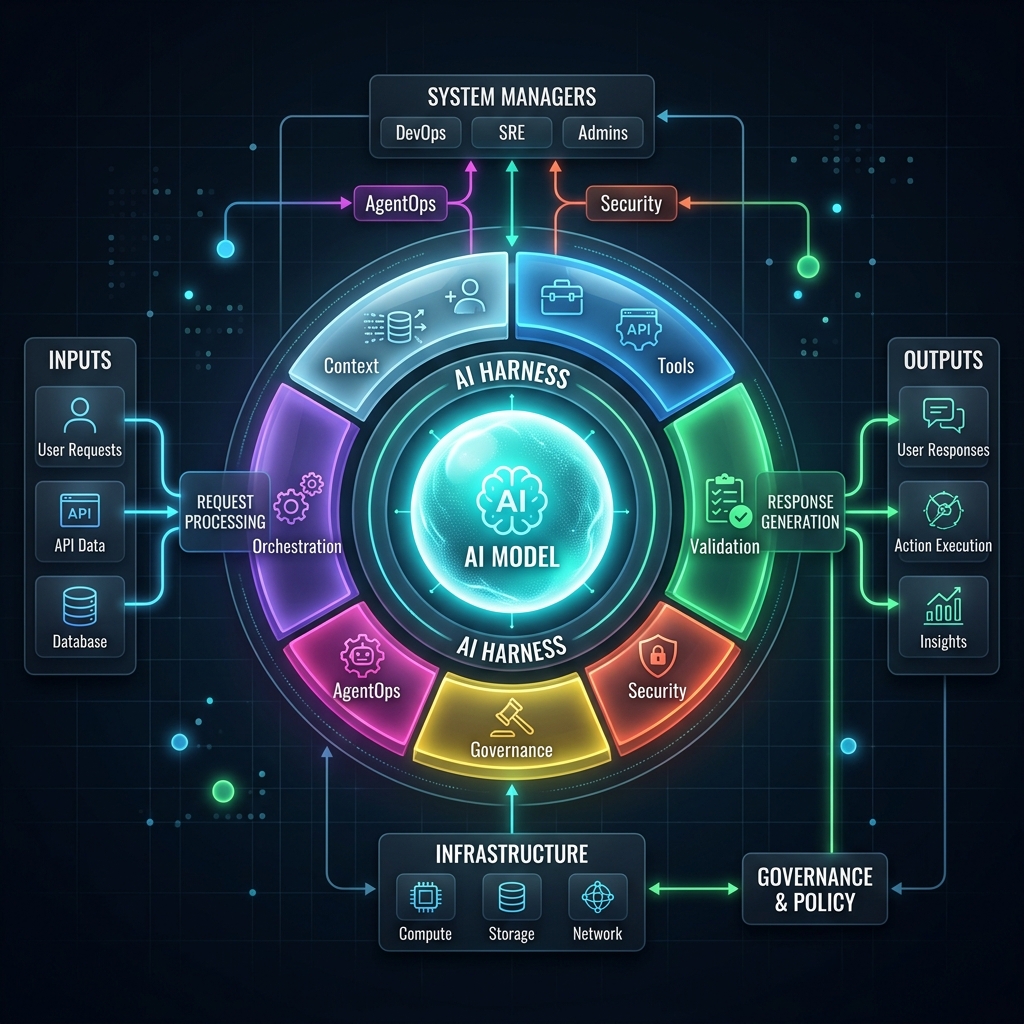
Leadership standardizes corporate data, establishes access controls, and creates an AI Governance Board. They build an "AI Harness" — a technical wrapper providing the AI with enterprise context, tools, and validation so it operates safely within corporate guidelines.
AI Agents autonomously handle Level 1 customer support, reconcile invoices, and process supplier documents under an AI Delegation Architecture. The workforce adopts a Human-led, AI-first philosophy — AI does the heavy lifting while humans handle exceptions and high-stakes decisions.
The organization rebuilds operations around AI. Multi-agent systems orchestrate complex supply chains in real time. KPIs shift from "time saved" to new revenue streams and organizational learning speed. The company is no longer using AI — it is an AI-Native enterprise.
Harness Engineering
What turns a model into a reliable system
The Harness is the technical layer wrapping the model — context, tools, validation, security, governance, AgentOps, and orchestration.
Get started
Assess your AI maturity
Our team applies the CASAN framework to help automotive software organizations identify their current maturity level, define a pragmatic roadmap, and accelerate their journey to AI-Native operations — with proven results across eight AI service domains.