Service Overview
Data Analysis & ML
FPT Automotive's eda-and-ml service turns vehicle data and engineering drawings into actionable insights. It covers predictive CAN safety (hazards 3-15s ahead), driver emotional context (18.7x faster Qualcomm SoC inference), EV telemetry diagnostics (MLP + XGBoost + LLaMA for battery DTCs), and quality inspection (screw detection in 2s, part drawing reviews cutting setup time 70%). Processed privacy-first and on-device.
18.7×
Qualcomm inference speedup
3-15s
CAN predictive safety warning
70%
Drawing review setup cut
2 seconds
Door panel screw inspection
35%
MBD platform manual savings
Capabilities
Key capabilities
Privacy-First Architecture
All analysis performed on-vehicle without transmitting sensitive information to cloud servers.
CAN Signal Analysis
Deep learning models trained on automotive CAN-bus data for predictive insights.
Anomaly Detection
Automatic identification of unusual vehicle behavior and potential failures.
Predictive Maintenance
Predict component failures before they occur, reducing downtime and maintenance costs.
Fleet Analytics
Aggregate insights across vehicle fleets for operational optimization.
Technology
Technology stack
| Component | Technology | Purpose |
|---|---|---|
| Data Collection | CAN-bus Interface | Vehicle signal acquisition |
| Processing | Python, Pandas | Data preparation and analysis |
| ML Models | TensorFlow, PyTorch | Predictive modeling |
| Analytics | Scikit-learn, XGBoost | Statistical analysis |
| Visualization | Tableau, Grafana | Dashboard and reporting |
Use cases
Real-world applications
Documented outcomes from actual deployments.
Predictive Safety Layer for Accident Prevention
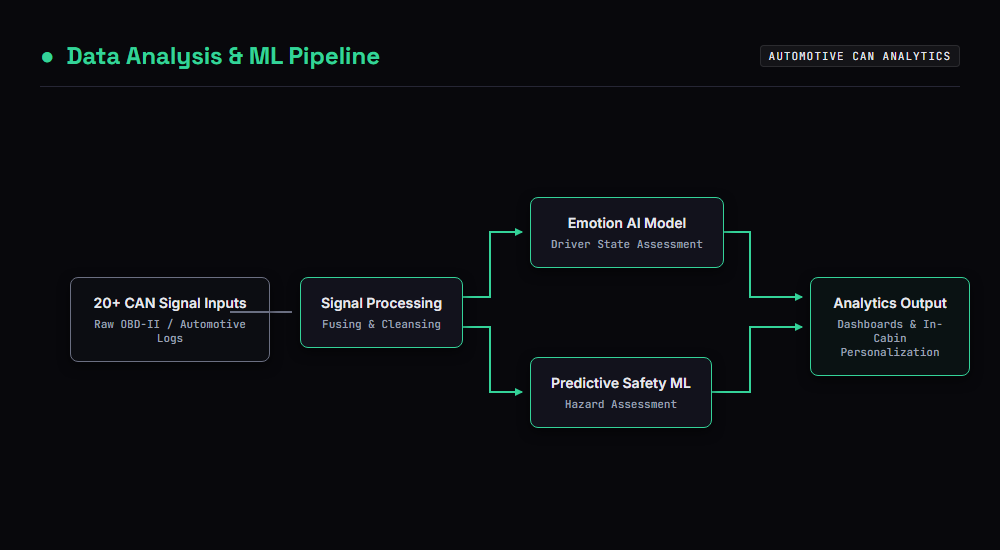
CAN-bus dynamics analysis to predict high-risk driving scenarios 3–15 seconds before potential incidents — targeting the 29% of rear-end collisions caused by driver inattention, without camera surveillance.
Before
Passive ADAS unable to anticipate subtle inattention risks; 29% of rear-end collisions from inattention
After
Proactive risk alerts 3–15 seconds ahead, bridging monitoring to active intervention
Driver Emotional Context AI System
Full-stack AI solution fusing 20+ CAN signals and driver behavior data on Qualcomm SA8255P SoC for real-time emotional context understanding and in-cabin personalization.
Before
No real-time driver state understanding; complex multi-signal fusion unresolved
After
Continuous inference at ≤100ms with 5.99% accuracy and 49.15% recall improvement
AI Door Panel Inspection — 3 min to 2s
Machine learning model for automated screw inspection on car door panels, trained on defect patterns and integrated into production workflow. Returns immediate pass/fail per door at production speed.
Before
3-minute manual inspection per door throttling throughput on high-volume lines
After
AI inspection at 99.7% accuracy in 2 seconds per door
AI-Powered Predictive Diagnostics for EVs
Multi-model diagnostic system combining MLP, XGBoost, and LLaMA to ingest real-time connected vehicle data (sensor, chassis, tire PSI, battery) and deliver predictive DTCs and battery health analysis via a conversational interface.
Before
Reactive diagnostics only; raw sensor data required specialist interpretation
After
Predictive fault warnings and battery diagnostics surfaced in natural language to vehicle owners
AI Part Drawing Review — 70% Setup Time Cut
Deep learning pipeline combining YOLO/Faster R-CNN, OCR, and transformer models to automatically detect dimensional errors, tolerance violations, and annotation inconsistencies in automotive engineering drawings.
Before
Hours of manual expert review per drawing; complex multi-view drawings prone to missed errors
After
Automated review with color-coded markup, severity-classified error reports, and compliance dashboard
How we work
Implementation approach
Phase 1: Data Strategy & Collection
- Define data collection strategy and privacy requirements
- Set up CAN-bus data collection infrastructure
- Establish data governance and security protocols
Phase 2: Model Development
- Analyze historical vehicle data
- Develop predictive models for key use cases
- Validate model accuracy and performance
Phase 3: Integration & Deployment
- Integrate models with fleet management systems
- Deploy to vehicle fleet
- Set up monitoring and alerting systems
Phase 4: Optimization & Scaling
- Monitor model performance in production
- Collect feedback and improve models
- Scale to additional vehicle platforms
Explore more
Related services
Edge AI
Low-latency, privacy-first on-device AI for driver monitoring, hybrid voice, and smart manufacturing.
In-Cabin AI Agent
Hybrid edge-cloud voice AI and CAN-bus predictive safety for next-generation digital cockpits.
System Test AI
AI-assisted end-to-end vehicle validation and HIL/SIL simulation compliance.