Service Overview
Refactoring AI
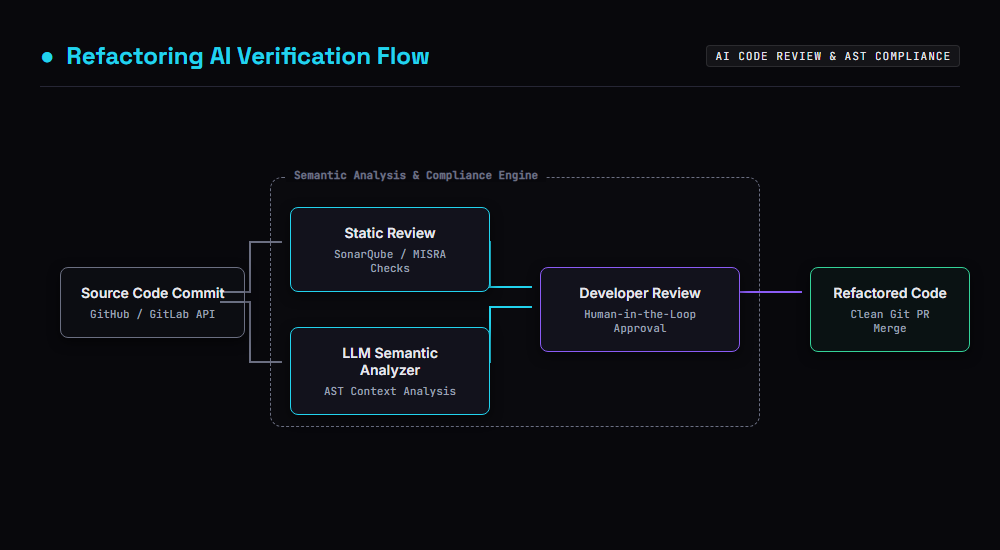
FPT Automotive's refactoring-ai automates code review, MISRA-C compliance, design documentation, and cross-platform porting for ECU/SoC migration. Integrates static analysis (SonarQube) with LLMs (GPT-4, Claude) across GitHub, GitLab, and Azure DevOps. Connects browser-based IDEs, DevBoxes, GHA CI, and SILS boards under Entra ID governance. Redesigns code reviews from 200–300 hours manual effort to 2–3 hours per 100K LOC, saving up to 90% in time and 97% in costs.
90%
Review time reduction
2-3 hours
Review time per 100K LOC
80%
Defect coverage rate
30-40%
Shorter dev cycles
97%
Cost savings vs manual
Capabilities
Key capabilities
Static Analysis Integration
Combines traditional static analysis tools with LLM semantic understanding for comprehensive code analysis.
MISRA Compliance
Automatically identifies and fixes MISRA violations in automotive C/C++ code.
Legacy Code Modernization
Transforms legacy code to modern standards while preserving functionality.
Automated Refactoring
AI-driven refactoring suggestions with automated implementation via AST manipulation.
Quality Verification
Automated verification of refactoring results to ensure correctness and no regression.
Technology
Technology stack
| Component | Technology | Purpose |
|---|---|---|
| Static Analysis | SonarQube, Clang Static Analyzer | Code quality analysis |
| LLM | GPT-4, Claude | Semantic code understanding |
| Refactoring | AST manipulation, Code generation | Automated refactoring |
| Verification | Unit tests, Static verification | Quality assurance |
| Development | Python, C++, Java | Implementation |
Use cases
Real-world applications
Documented outcomes from actual deployments.
AI Code Review — 90% Time Reduction
Cloud AI replaced manual code review for 100K+ line codebases — cutting analysis from 200–300 hours to 2–3 hours while maintaining ~80% defect coverage. Engineers shift from surface reviews to high-level architecture decisions.
Before
200–300 hours manual review, $7K–9K cost per 100K LOC, diverting engineering resources
After
2–3 hours Cloud AI analysis, $250–500 cost, engineers focus on architecture
Development Cycle Acceleration
Refactoring AI integrated into development phases — requirements analysis, design, and testing — reducing the 14–22 month traditional cycle and cutting defect rates across projects.
Before
14–22 month development cycles, high defect rates, missed deadlines
After
30–40% shorter development cycles, 25–40% fewer defects
MISRA-C Compliance & LLM Code Analysis
LLMs combined with static analysis for deep semantic code understanding — automated MISRA-C compliance checks, design documentation generation, and architectural gap reporting across codebases.
Before
Manual compliance verification, fragmented documentation, slow code comprehension
After
Automated MISRA-C checks, AI-generated docs, faster architectural understanding
How we work
Implementation approach
Phase 1: Codebase Analysis
- Analyze existing codebase and identify quality issues
- Assess MISRA compliance and technical debt
- Plan refactoring strategy and priorities
Phase 2: Refactoring Development
- Develop refactoring rules and transformations
- Create automated refactoring implementations
- Validate refactoring correctness
Phase 3: Integration & Testing
- Integrate with development workflow
- Conduct comprehensive testing of refactored code
- Ensure no functionality regression
Phase 4: Deployment & Monitoring
- Deploy to development teams
- Monitor code quality improvements
- Continuously improve refactoring rules
Explore more
Related services
Data Analysis & ML
Predictive safety, driver context on Qualcomm, EV diagnostics, and drawing reviews powered by ML.
Unit Test AI
AI unit test generation at 85-90% accuracy, virtualized execution, and MBD check-rule automation.
System Test AI
AI-assisted end-to-end vehicle validation and HIL/SIL simulation compliance.