Service Overview
Unit Test AI
FPT Automotive's unit-test-ai accelerates unit testing via Azure AI and AST analysis. It reduces test case creation from 20-40 min to 5-7 min at 85-90% accuracy, automates MBD rule checks (70% coverage, 20 min saved per model), and integrates with GHA CI, VS Code DevBoxes, and virtualized SILS boards. Establishes a tighter validation loop with centralized test data management under Entra ID governance.
5-7 mins
Test case generation time
85-90%
Test generation accuracy
70%
MBD rule-check coverage
35%
Testing manual effort cut
18.7×
Model validation speedup
Capabilities
Key capabilities
Automated Test Generation
AI generates comprehensive unit tests from source code, reducing manual test writing effort significantly.
Code Coverage Optimization
Intelligent test generation targeting uncovered code paths for maximum coverage.
Digital Cockpit Expertise
Specialized models trained on automotive cockpit software patterns and requirements.
IVI/Cluster/HUD Support
Comprehensive testing for all major cockpit components.
CI/CD Integration
Seamless integration with continuous integration and deployment pipelines.
Technology
Technology stack
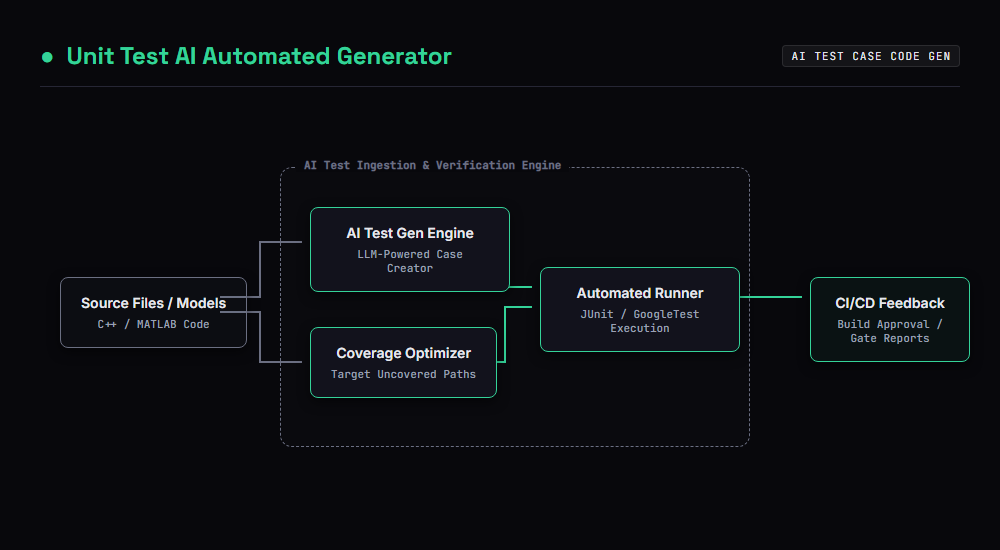
| Component | Technology | Purpose |
|---|---|---|
| AI Model | LLM, GPT-based | Test generation |
| Testing Framework | JUnit, CppUnit, GoogleTest | Test execution |
| Code Analysis | Static analysis tools | Code understanding |
| CI/CD | Jenkins, GitLab CI | Automation pipeline |
| Development | Python, C++, Java | Implementation |
Use cases
Real-world applications
Documented outcomes from actual deployments.
Accelerated AI Unit Testing Process
AI automatically generates test cases from models and requirements, replacing the 20–40 minute manual process with a 5–7 minute AI-powered workflow at 85–90% accuracy.
Before
20–40 minutes manual test case creation per task, 1–2 month testing phases
After
5–7 minutes AI generation per task, 0.5–1 month testing phases
MBD Check-Rule Automation
AI Check-Rule Model automates rule violation detection in Model-Based Design, achieving 70% coverage of rule checks and saving approximately 20 minutes per model.
Before
30–40 minutes manual rule checking per model, consistency issues, human fatigue errors
After
AI achieves 70% check coverage automatically; 20 minutes saved per model
AI Model Performance Validation
Comprehensive validation pipeline for automotive AI models — ensuring performance targets are met across accuracy, recall, and inference speed before production deployment.
Before
Inadequate baseline performance for real-time safety-critical requirements
After
5.99% accuracy gain, 49.15% recall improvement, 18.7× faster inference (quantized)
How we work
Implementation approach
Phase 1: Codebase Analysis
- Analyze existing codebase and test patterns
- Identify key components and testing requirements
- Define test generation rules and constraints
Phase 2: Model Training & Customization
- Train AI models on automotive cockpit code patterns
- Customize for specific OEM requirements
- Validate test quality and coverage
Phase 3: Integration & Validation
- Integrate with CI/CD pipeline
- Validate generated tests against existing test suites
- Ensure compatibility with testing frameworks
Phase 4: Deployment & Optimization
- Deploy to development teams
- Monitor test generation quality and coverage
- Continuously improve based on feedback
Explore more
Related services
Refactoring AI
Automated code review, MISRA-C compliance, and safe API porting for SDV migrations.
Data Analysis & ML
Predictive safety, driver context on Qualcomm, EV diagnostics, and drawing reviews powered by ML.
System Test AI
AI-assisted end-to-end vehicle validation and HIL/SIL simulation compliance.